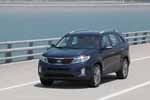

Kia’s designers developed new front and rear bumpers with vertical-axis fog lights, a new front grille and headlamps with LED positioning lights, and a new tailgate with reshaped LED combination lamps.

Access is improved by the lower ride height (-10 mm), and the cabin floor has also been lowered, increasing legroom by 30 mm (2nd row) and 9 mm (3rd row). The interior can be trimmed in black or beige cloth or leather. A new two-part glass panoramic roof with a single powered roller blind shade will be also available.

Sorento will be manufactured in Korea with a wide range of different gasoline and diesel engines from 150 to 280hp. The revised 2.4-liter Theta II GDI engine is fitted with a new cylinder head, pistons, fuel injection and intake systems. It generates 9% more power (192hp) and 6.6% more torque (242Nm), than the similar capacity MPI (multi-point injection) engine available in some markets, while delivering better fuel economy and lower emissions, from 199g/km.
The 2.2-liter, 197hp TCI (turbocharged inter-cooler) engine features a new exhaust gas recirculation (EGR) system which reduces CO2 emissions – down to as little as 153 g/km. Maximum torque is 436Nm (automatic models) and 421Nm (manual).

Every model will feature a six-speed transmission (manual or automatic) and a choice of 2WD (front-wheel drive) or 4WD (four-wheel drive) – depending on model. The 4WD drivetrain is an ‘on-demand’ system that delivers 100% of engine torque to the front wheels during all routine city and highway driving. Whenever a front wheel loses grip a percentage of torque (up to 50%) is automatically transferred to the rear wheels. In severely slippery conditions the driver can select ‘Lock Mode’ which delivers 50% of torque to both the front and rear axles.
